
























Many people are eating more consciously today than ever before.
More vegetables. Less sugar. Good fats. High-quality protein.
And yet the gut still complains. Flatulence, discomfort, sluggishness or the feeling that something is not running smoothly. We often look for the cause in stress, hormones or intolerances.
However, the gut is often missing something quite banal. And at the same time something enormously important: Dietary fiber.
Why dietary fiber is so important for the gut
The term dietary fiber is misleading.
It sounds like something you don't need.
In reality, fiber is the favorite food of your intestinal bacteria. They are not digested in the small intestine. They enter the large intestine. And that's where their real job begins.
Your intestinal bacteria ferment fiber and produce so-called short-chain fatty acids in the process. One of these is particularly important. We'll come to that in a moment.
The gut is more than just a digestive organ
The gut is not a passive digestive tube or simply a pipe that passes through the body. It is a highly complex, living organ with several tasks at the same time
:- absorb nutrients
- regulate the immune system
- fight off pathogens
- communicate with the brain
The intestinal mucosa forms a central protective layer.
It separates the inside of our body from everything that passes through the intestine.
This mucous membrane is constantly renewing itself. And it needs building material for this. Because without replenishment, it becomes thinner.
And more susceptible.
And now we come to these building materials.
Butyrate: the key to a healthy intestinal mucosa
Butyrate is the most important source of energy for the cells of the intestinal mucosa. You can imagine it like this: Without butyrate, these cells run in economy mode.
Butyrate supports
- the regeneration of the intestinal mucosa
- the barrier function of the intestine
- a balanced intestinal environment
- inflammation-regulating processes
Without sufficient fiber, less butyrate is produced.
Not none at all. But often too little.
This leads to a weaker barrier in the long term. Unfortunately, this does not become noticeable immediately, but rather gradually.
The intestinal mucosa as a protective layer
The intestinal mucosa is covered by a fine layer of mucus. This layer protects the intestine and keeps unwanted substances at bay.
The mucus consists mainly of so-called mucins. These are special protein compounds (amino acids) to which many small sugar molecules are bound.
In order for this protective mucus to remain stable, the body needs a constant supply of these building blocks. This is where the intestinal bacteria come into play.
Certain intestinal bacteria react to complex carbohydrates and selected dietary fibers. They use them as food and at the same time as a signal. This stimulates the formation of protective mucus and the mucus layer remains intact.
It is important to note that not all dietary fibers have the same effect. Some are particularly suitable for supporting these processes and stabilizing the mucus layer.
What intestinal bacteria do with fiber
The intestinal mucosa is constantly renewing itself, but not always equally well. In order for this renewal process to run smoothly, the intestine needs certain signals.
Such signals are generated in the large intestine when intestinal bacteria break down dietary fiber.
In doing so, they form so-called short-chain fatty acids.
These include not only the butyrates already described but also acetate and propionate. These substances act like messenger substances in the intestine.
They give the cells of the Intestinal mucosa important information:
- when they should renew themselves
- how stably they bind together
- and how strongly inflammatory processes are slowed down or regulated
If there is a lack of fiber in the diet, fewer of these messenger substances are produced.
This can throw the renewal and coordination of the intestinal mucosa out of balance in the long term.
What happens if there is a long-term lack of fiber
If too little fermentable fiber reaches the intestine, several processes become unbalanced
:- the intestinal mucosa becomes thinner, as just explained in detail
- the protective function decreases
- certain bacteria increasingly attack the mucous layer
- the microbiome loses diversity
This does not happen overnight. It is the result of a diet that is intended to be healthy but provides the gut with too little of what it really needs.
Why the amount of fiber is crucial
A few vegetables are often not enough
A few vegetables here. A salad there. Maybe oatmeal in the morning.
That feels healthy. But it's often not enough.
For stable butyrate formation, the gut needs
- regular fiber intake
- different types of fiber
- and above all: enough quantity
The intestine doesn't just need fiber.
It needs enough of it every day.
We recommend 30g per day. However, I have also heard from experts that 50g would be better. Just to give you an idea of what 30g means:
100g of green salad has about 2g of fiber.
150g of vegetables or fruit about 3g, 60g of oatmeal about 6g and 100g of wholemeal bread about 7g.
Why many people eat too little fiber despite a healthy diet
The problem is structural
:- Many foods are highly processed
- Pulses are rarely on the plate
- Portions have become smaller (with our sedentary lifestyle, we need far fewer calories than people used to need for physical work!)
- Time and tolerance play a major role
Not every intestine can tolerate large amounts of fiber straight away. Flatulence is then not a sign of intolerance, but of overstraining.
When food alone is not enough
You may have read this far and thought: This all makes sense to me. But I really can't manage it in my everyday life.
And that's an important point.
Not everyone's gut can handle large quantities of vegetables or pulses without problems. Not everyone has time to consciously plan every day. And not everyone wants to or can eat huge portions every day just to get a certain amount of fiber.
Well-tolerated dietary fiber as support
Dietary fiber from foods is and remains the basis of a gut-friendly diet.
At the same time, there are situations in which it can be useful to supplement this basis in a targeted manner instead of trying to force it through food.
It is not only the quantity that plays a role here, but also the type of fiber.
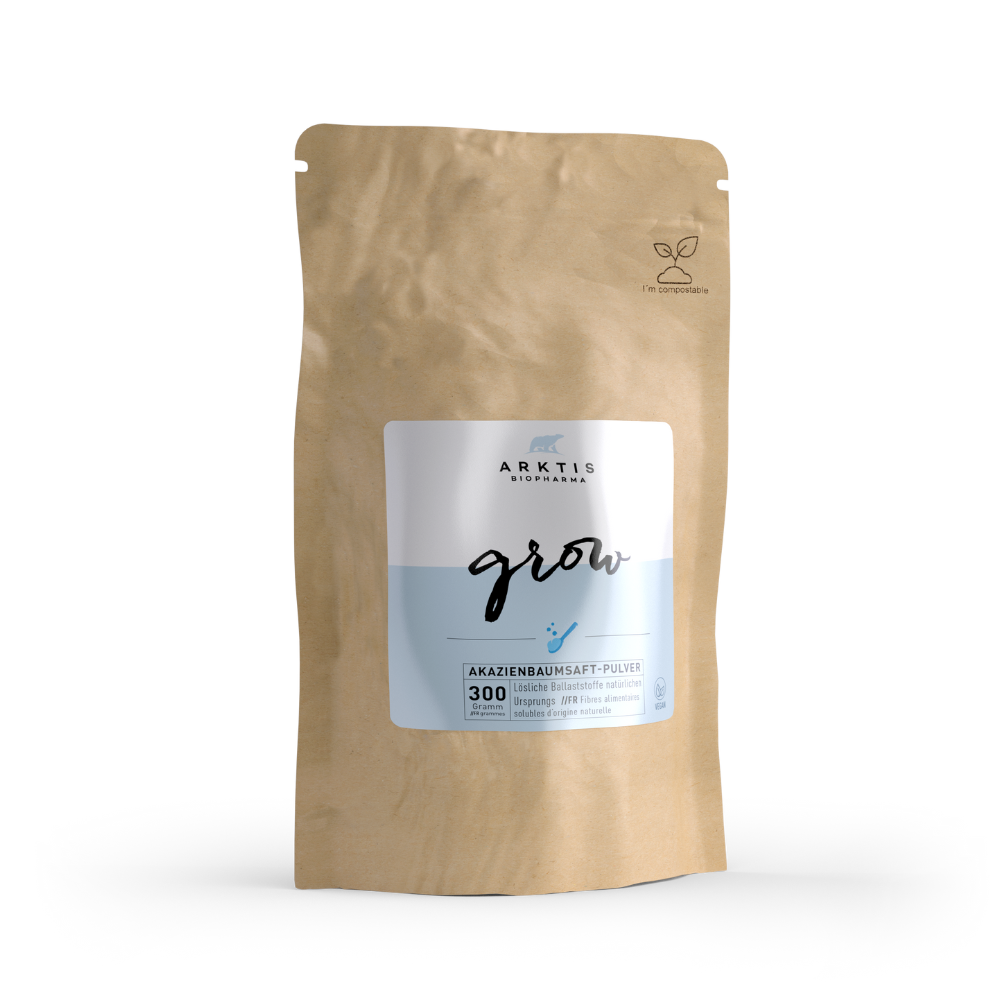
There are fibers that are fermented very slowly and are therefore generally well tolerated. Acacia fibers, for example. They increase the daily fiber intake without overtaxing the intestines and provide a continuous supply for the intestinal bacteria.
Special dietary fibres for the intestinal mucosa
And there are very specific types of dietary fibres that do not primarily serve to increase volume, but instead have a targeted effect. serve as food for certain intestinal bacteria. These are particularly interesting in connection with the intestinal mucosa and the formation of short-chain fatty acids such as butyrate.
This includes 2'fucosyllactose.
Such dietary fibers do not replace a balanced diet. But they can be a useful bridge between what is theoretically recommended and what is feasible in real life.
As pragmatic support for an intestine that needs daily replenishment.
How much fiber is realistic in everyday life?
You may be asking yourself now: How much fiber is realistic? And what does that actually look like in everyday life?
That's exactly what I looked at. Not theoretically. But with normal foods and realistic meals.
Free download: the fiber reality check
In our free pdf mini-guide we show you
- three realistic daily examples
- divided into breakfast, lunch and dinner
- with specific quantities
- and the respective fiber sum
Not as an ideal plan. But as an honest look at everyday life.
👉 [Download the fiber reality check]
Conclusion: Your gut needs replenishment
Fiber is not a side issue.
It is central to the nutrition of your intestinal bacteria and the stability of your intestinal mucosa. Perfection is not necessary. Awareness is.