


















I admit it: when Roman first told me about CO₂ breathing training, I was skeptical. CO₂? Isn't that the gas we exhale? And even worse: the gas that is destroying our environment? That's supposed to make us healthy?
But Roman has always had a sense for things that seem counterintuitive at first glance and change everything at second glance. That was the case with gut health. It was the same with the realization that more oxygen is not always better. And so it is now with the Cardihaler.
The feedback is impressive
What really convinced me? Not the theory. Not the studies. They are impressive. But it was above all the feedback from the numerous users that made me sit up and take notice.
And also the experience that Roman had after his cervical vertebra surgery. He did CO₂ breathing training before the operation and immediately after waking up, speeding up his recovery and reducing his hospital stay to just one day!
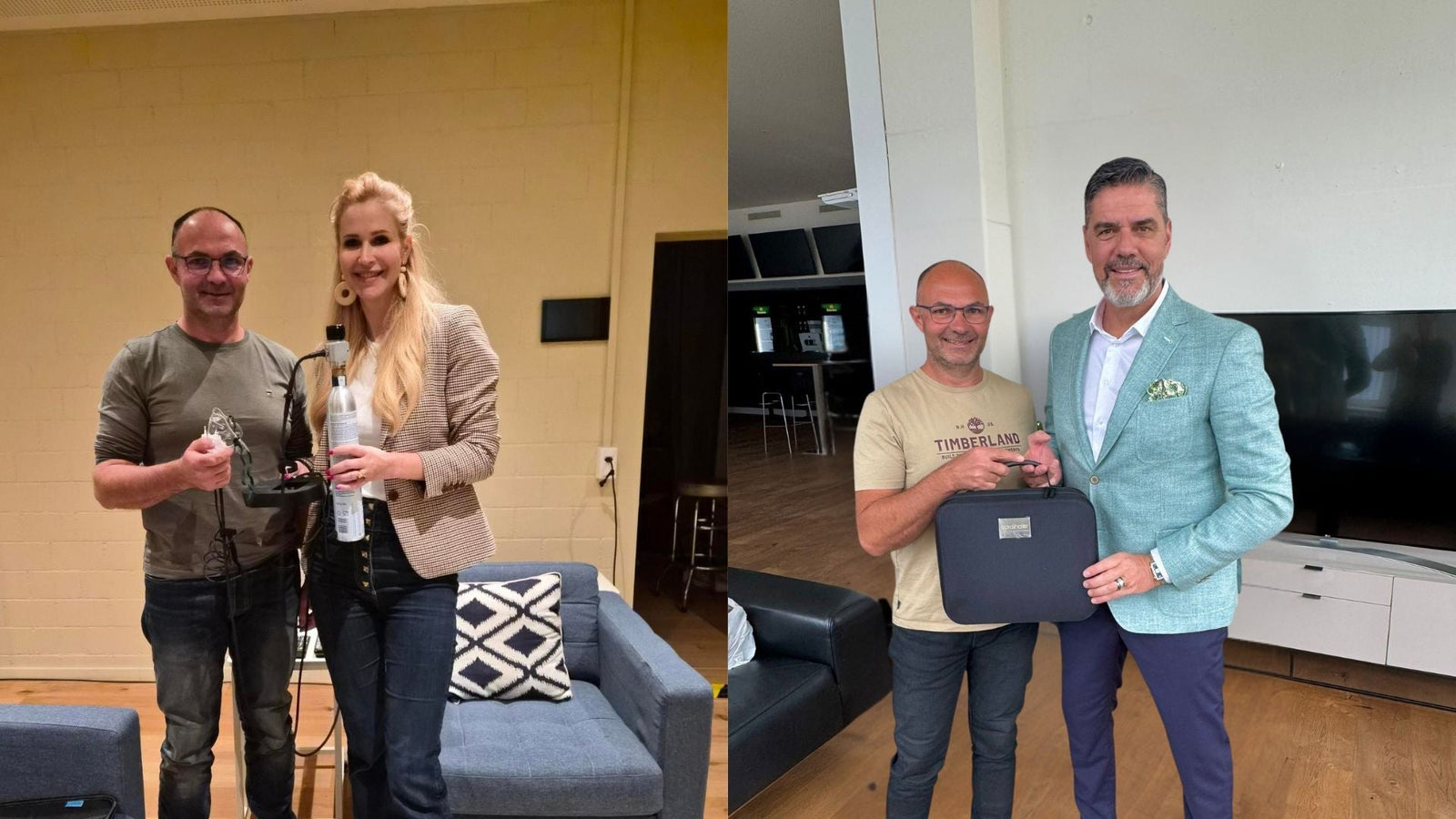
That's why we were delighted that TV maker Claudia Lässer reported after her 30-day test of CO₂ training with the Cardihaler:
"It gives me a very clear head. That really impressed me. It brings you down immediately, you relax very quickly. Completely new for me."
- Claudia Lässer, CEO Blue TV
Claudia is not someone who is quick to exaggerate. She is an entrepreneur, CEO, mother and someone who hardly has time in her day to not be fully present. When she says "completely new", she means it.
And that's exactly why I'm telling you today what's behind the CO₂ training and our Cardihaler Challenge.
The prejudice we all carry with us
CO₂. Most people immediately think of exhaust fumes, climate change and bad air. We learned in school that oxygen is good, CO₂ is waste. Breathe in, breathe out, done.
But the body is more complicated than what we learned at school.
CO₂ is not a waste product in the body. It is a control signal. It regulates whether your nervous system remains in alarm mode or whether it is finally allowed to let go. It determines whether oxygen actually reaches the brain and muscles or whether it is simply exhaled again without ever having been used.
This principle is called the Bohr effect, and it explains why so many people are chronically exhausted, tense and unable to concentrate despite having "enough air".
The oxygen paradox: why more is not always better
This is where it gets exciting. And I think this is the real aha moment of the whole thing.
Too much oxygen, combined with too little CO₂, harms the body.
Stress, incorrect breathing (e.g. through the mouth instead of the nose) and lack of exercise mean that most people breathe out too much CO₂.
The body reacts to this with oxidative stress, inflammation and tension.
CO₂, on the other hand, is a natural protective shield. It dilates the blood vessels, calms the nervous system and ensures that oxygen ends up exactly where it is needed: in the brain, muscles and organs.
Oxygen activates. CO₂ relaxes. The balance between the two is the key to real recovery.
And it is precisely this balance that many people have long since lost in stressful everyday life.
If you would like to read more about why CO₂ brings oxygen to where it is needed, we can also recommend this article: Areyou breathingwrong? 5 facts about CO₂ that could change the way you think.
What the research says
The developer of the Cardihaler, a Swede called Anders Olson, spent years researching CO₂ before creating the Cardihaler. Some of the figures he came up with are remarkable:
- 5% CO₂ inhalation increased blood flow to the brain by 54.5%
- Higher CO₂ combined with reduced oxygen increased sprint performance by 64%, compared to only 6% in the control group
- CO₂ inhalation stopped epileptic seizures within seconds
- CO₂ inhalation accelerated the detoxification of alcohol and carbon monoxide
No wonder top international athletes such as Chris Fürich from VfB Stuttgart and the German national team rely on the Cardihaler.
His conclusion: he doesn't get tired after using it and feels fit to play from the very first minute.
These are not marketing promises. These are real experiences from real people.
5 minutes. That's all.
What really excites me about the Cardihaler is its simplicity. No complicated technology. No long instructions. No app.

You connect a small CO₂ gas cylinder, which you can get in most supermarkets, to the Cardihaler. You switch the device on, select the duration and amount of CO₂ concentration and breathe calmly and evenly through the mask provided.
Just 5 minutes a day can have a positive effect.
No matter when, whether in the morning before the first meeting, at lunchtime as a short reset or in the evening when your head just won't stop thinking.
Many people report a noticeable change after the very first session. After a few days, they describe themselves as calmer, clearer and more present. Exactly what Claudia Lässer described after 30 days.
An idea that inspires us: the Cardihaler Challenge
We didn't want a traditional advertising campaign. We wanted real experiences, from people you trust, people you know, who simply tell you honestly what they have experienced.
That's how the idea of the Cardihaler Challenge came about: 12 well-known Swiss personalities. 12 months. A device that is passed from hand to hand. Each person tests the Cardihaler for 30 days and at the end decides for themselves who will be next.
Claudia Lässer: "Completely new to me
"
The challenge was opened by Claudia Lässer. As CEO of Blue TV and a successful entrepreneur,she is exactly the type of person we had in mind: someone who does a lot, has little time and has realized that her health is her capital.
What Claudia said after 30 days touched us.
Clear head. Deep relaxation. Completely new.
You can watch her full feedback video here: Claudia Lässer about the Cardihaler

Zuberbühler: We are excited
Claudia's choice for the next 30-day test delighted us: Pascal Zuberbühler, former goalkeeper of the Swiss national football team.
As a former top athlete and now a sought-after football expert who travels a lot, he knows exactly what real recovery means and why it is so important.
Pascal has had the Cardihaler with him for a few days now. At home, in the office, on the road. What will he say after 30 days? We will tell you.
And the big question remains: Who will Zubi nominate?
Follow us on Instagram to find out what happens with the Cardihaler Challenge in April!
One last thought from me
I think most people have never learned to breathe properly. I don't exclude myself from this, because even as a child I had a few things wrong with me as far as this was concerned.
But it's great that this can still be corrected and trained as we get older, and that's why the Cardihaler is so valuable to me. Because it's just: Once a day. Five minutes. Just breathe.
If that was "completely new" for Claudia Lässer, maybe it is for you too.